W#12: Matrices, Probability, Random Variables in Data Science

Jan Lorenz

Packages

library(tidyverse)
library(tidymodels)
library(palmerpenguins)
library(openintro)

Matrices

What is a matrix?

  • A matrix is a 2-dimensional array of numbers with rows and columns.
  • The numbers in it are called its elements.

Isn’t that a data frame? No.

  • In a matrix, every element has the same basic data type! In a dataframe every column can be of different data type.
  • In R, a matrix is an atomic vector plus specification of the matrix dimensions.
  • In matrices, columns often do not have names.
matrix(data = 1:6, nrow = 2)
     [,1] [,2] [,3]
[1,]    1    3    5
[2,]    2    4    6
matrix(data = 1:6, ncol = 2)
     [,1] [,2]
[1,]    1    4
[2,]    2    5
[3,]    3    6
matrix(data = 1:6, nrow = 3)
     [,1] [,2]
[1,]    1    4
[2,]    2    5
[3,]    3    6
matrix(data = 1:6, nrow = 3, byrow = TRUE)
     [,1] [,2]
[1,]    1    2
[2,]    3    4
[3,]    5    6

Note: A matrix can also be of characters or logicals, it can also have row- and column-names.

Matrices in Data Science?

  • Matrices are the basic data structure for many algorithms in data science. For examples
    • Principal Compontent Analysis (PCA)
    • Ordinary Least Squares (OLS) regression to estimate coefficients in a linear model
  • The mathematical field dealing with matrices is called Linear algebra.
    • A linear function \(f: \mathbb{R}^n \to \mathbb{R}^m\) can be represented by an \(m\)-by-\(n\) matrix.
Matrices and Vectors

The elements1 of an \(m\)-by-\(n\) matrix \(A\)

A matrix can be interpreted

  • as \(n\) column vectors of length \(m\) and
    \(\downarrow\dots\downarrow\)
  • as \(m\) row vectors of length \(n\). \(\begin{array}{c}\rightarrow \\[-5mm] \vdots \\[-5mm]\rightarrow\end{array}\)

In R and python, a vector is not specified as row or columns. In matrix terminology a

  • column vector is a \(m\)-by-1 matrix \(\left[\begin{array}{c} a_{1} \\ \vdots \\ a_{m}\end{array}\right]\)

  • row vector is a 1-by-\(n\) matrix \(\left[\begin{array}{c} a_{1}\ \cdots\ a_{n}\end{array}\right]\)

Convention: If a vector is not specified as row or column it is usually treated as columns if that is relevant.

Square and Diagonal Matrices

  • A square matrix has the same number of rows and columns, \(n\)-by-\(n\)
  • A diagonal matrix is a matrix where all elements outside the main diagonal are zero.
    \(\left[\begin{array}{ccc} a_{11} & & 0 \\ & & \ddots & \\ 0 & & a_{nn} \\ \end{array}\right]\)
  • The identity matrix
    \(\left[\begin{array}{ccc} 1 & 0 & 0 & 0 \\ 0 & 1 & 0 & 0 \\ 0 & 0 & 1 & 0 \\ 0 & 0 & 0 & 1 \end{array}\right]\)

diag works two ways

diag(c(1,2,3))
     [,1] [,2] [,3]
[1,]    1    0    0
[2,]    0    2    0
[3,]    0    0    3
D <- matrix(1:9, nrow = 3)
D
     [,1] [,2] [,3]
[1,]    1    4    7
[2,]    2    5    8
[3,]    3    6    9
diag(D)
[1] 1 5 9

Transposition of Matrices

  • Transposition of a matrix is done by flipping the matrix over its diagonal.
  • In math the transpose of \(A\) being \(m\)-by-\(n\) is written \(A^T\) and is \(n\)-by-\(m\)
  • In base R the function t() transposes
A <- matrix(1:12, nrow = 3)
A
     [,1] [,2] [,3] [,4]
[1,]    1    4    7   10
[2,]    2    5    8   11
[3,]    3    6    9   12
t(A)
     [,1] [,2] [,3]
[1,]    1    2    3
[2,]    4    5    6
[3,]    7    8    9
[4,]   10   11   12
  • Transposes of vectors make rows to columns and vice versa
    • When \(x\) is a row vector \(x^T\) is a column vector
    • For Data Frames: Transposition makes every case a variables and every variable a case.
  • Interesting behavior in R (an atomic vector becomes a matrix)
x <- 1:4
x
[1] 1 2 3 4
t(x)
     [,1] [,2] [,3] [,4]
[1,]    1    2    3    4
t(t(x))
     [,1]
[1,]    1
[2,]    2
[3,]    3
[4,]    4

Matrix and Vector manipulation

  • Matrices of equal dimension and vectors of equal length are added (\(A+B\), \(x+y\)) and subtracted element-wise
    • We do it a lot in data science. For example: Create a new column as the sum of two existing ones
  • Matrices and vectors can be scaled by single numbers (\(\alpha A\), \(\alpha x\)) (Scalar product)
    • We do it a lot in data science.

Think vectorized!

Matrix Multiplication

  • Matrix multiplication \(A\cdot B\) is a bit more complicated than addition and scalar multiplication.
    • Matrix multiplication is different from multiplying numbers because \(A\cdot B \neq B\cdot A\)
  • You have to think row-wise on \(A\) and column-wise on \(B\)

Matrix Multiplication in R

A <- matrix(1:6, nrow = 2)
B <- matrix(7:12, nrow = 3)
A
     [,1] [,2] [,3]
[1,]    1    3    5
[2,]    2    4    6
B
     [,1] [,2]
[1,]    7   10
[2,]    8   11
[3,]    9   12
A %*% B
     [,1] [,2]
[1,]   76  103
[2,]  100  136
B %*% A
     [,1] [,2] [,3]
[1,]   27   61   95
[2,]   30   68  106
[3,]   33   75  117

Length and Inner Product of Vectors

  • The inner product of two vectors \(x\) and \(y\) is \(x^Ty = \sum_{i=1}^n x_i y_i\).
    • In \(A\cdot B\) each element of the new matrix is an inner product of a row of \(A\) and a column of \(B\).
  • The length of a vector \(x\) is \(\|x\| = \sqrt{x^Tx} = \sqrt{\sum_{i=1}^n x_i^2}\).
    • The length of a vector is the square root of the inner product of the vector with itself.
      • This is the Euclidean distance (derived from Pythagorean theorem)
  • Think of an inner product as relating the length of the vectors and their angle like this

(In the graphic \(x\cdot y\) stands for \(x^Ty\))

Orthogonality of Vectors

  • Two vectors are orthogonal if their inner product is zero \(x^Ty = 0\).
  • This term can also be used for data!

Think of palmer penguins dummy variables

  • Which rows are orthogonal and what does it mean?
  • Which columns are orthogonal and what does it mean?
ID sex male species Chinstrap species Gentoo
1 0 1 0
2 0 1 0
3 0 0 1
4 1 0 1
5 1 0 0
6 1 0 0
7 1 1 0

Linear Models

This is the equation of a model:

average flipper_length_mm \(= \beta_0 + \beta_1\cdot\) body_mass_g \(+ \beta_2\cdot\) bill_length_mm $ + _3$ bill_length_mm

More mathy renamed: \(Y = \beta_0 + \beta_1X_1+ \beta_2X_2 + \beta_3X_3+ \varepsilon\)
We also add \(\varepsilon\) as the unknown error the model cannot capture. (So, we do not need to write “average” \(Y\))

For matrix description we join \(X_1\), \(X_2\), and \(X3\) as columns in the matrix \(X\) and put a matrix of ones as \(X_0\) for the intercept as another column, and the intercept \(\beta_0\) and the coefficients \(\beta_1\), \(\beta_2\), and \(\beta_3\) into a vector \(\beta\).

The matrix form: \(Y = X\cdot\beta + \varepsilon\)

penguins <- na.omit(penguins)

peng_fit <- linear_reg() |> 
 set_engine("lm") |> 
 fit(flipper_length_mm ~ body_mass_g + bill_length_mm + bill_depth_mm, data = penguins) 

beta <- peng_fit$fit$coefficients
beta
   (Intercept)    body_mass_g bill_length_mm  bill_depth_mm 
  156.78217410     0.01096719     0.58843506    -1.62201792 
X <- penguins |> 
 select(body_mass_g, bill_length_mm, bill_depth_mm) |> 
 mutate(intercept = 1) |> # We add a column of ones for the intercept
 select(intercept, everything()) |> 
 as.matrix()
Y <- matrix(penguins$flipper_length_mm, ncol = 1)

# These are our predictions in computed in matrix language
X %*% beta
           [,1]
  [1,] 190.5852
  [2,] 193.4776
  [3,] 186.9432
  [4,] 184.9096
  [5,] 186.5244
  [6,] 190.5565
  [7,] 199.3289
  [8,] 187.5144
  [9,] 186.7843
 [10,] 191.1731
 [11,] 190.0256
 [12,] 186.5731
 [13,] 197.5673
 [14,] 183.6451
 [15,] 195.0390
 [16,] 186.6305
 [17,] 188.1163
 [18,] 188.4396
 [19,] 193.2223
 [20,] 193.3901
 [21,] 188.5731
 [22,] 189.4366
 [23,] 186.6747
 [24,] 183.4610
 [25,] 193.2781
 [26,] 188.5810
 [27,] 192.0855
 [28,] 187.3452
 [29,] 192.9651
 [30,] 187.0928
 [31,] 191.1381
 [32,] 190.4935
 [33,] 190.5403
 [34,] 183.7941
 [35,] 200.2188
 [36,] 183.6104
 [37,] 193.7173
 [38,] 181.9568
 [39,] 199.0341
 [40,] 184.0437
 [41,] 200.0394
 [42,] 187.7112
 [43,] 186.7685
 [44,] 192.8001
 [45,] 189.7597
 [46,] 196.8812
 [47,] 186.1801
 [48,] 194.2842
 [49,] 179.5295
 [50,] 191.5525
 [51,] 190.2794
 [52,] 191.8540
 [53,] 182.5911
 [54,] 189.0538
 [55,] 184.9239
 [56,] 195.1156
 [57,] 190.8149
 [58,] 195.8633
 [59,] 181.7212
 [60,] 195.3852
 [61,] 188.1350
 [62,] 194.9518
 [63,] 184.4314
 [64,] 198.7156
 [65,] 185.1583
 [66,] 193.0700
 [67,] 191.1190
 [68,] 198.5902
 [69,] 189.8649
 [70,] 198.5704
 [71,] 194.1779
 [72,] 189.9769
 [73,] 190.9026
 [74,] 194.4435
 [75,] 184.3383
 [76,] 205.0243
 [77,] 189.5591
 [78,] 192.0313
 [79,] 186.5990
 [80,] 187.0911
 [81,] 188.1884
 [82,] 186.7111
 [83,] 191.4969
 [84,] 188.6603
 [85,] 187.5265
 [86,] 198.7673
 [87,] 186.3409
 [88,] 199.5297
 [89,] 186.2144
 [90,] 197.2931
 [91,] 189.6106
 [92,] 198.1961
 [93,] 181.9497
 [94,] 197.1607
 [95,] 189.1961
 [96,] 200.2876
 [97,] 186.7380
 [98,] 193.1952
 [99,] 180.9934
[100,] 188.4204
[101,] 192.7240
[102,] 189.5921
[103,] 186.4481
[104,] 203.7526
[105,] 194.3878
[106,] 201.1369
[107,] 186.5283
[108,] 196.8695
[109,] 189.2805
[110,] 196.9167
[111,] 183.7263
[112,] 186.8806
[113,] 186.9551
[114,] 187.2632
[115,] 184.7315
[116,] 185.2354
[117,] 190.6998
[118,] 193.6339
[119,] 185.1549
[120,] 193.7231
[121,] 186.9835
[122,] 198.6782
[123,] 185.4446
[124,] 197.4046
[125,] 186.8687
[126,] 189.3862
[127,] 186.8144
[128,] 197.9193
[129,] 188.2167
[130,] 195.3536
[131,] 184.1660
[132,] 191.4293
[133,] 189.0794
[134,] 197.7195
[135,] 189.9892
[136,] 190.8849
[137,] 183.9796
[138,] 194.0100
[139,] 184.3825
[140,] 189.4297
[141,] 196.2899
[142,] 186.5848
[143,] 186.9307
[144,] 190.7935
[145,] 190.8079
[146,] 195.0637
[147,] 211.8508
[148,] 222.2780
[149,] 211.3725
[150,] 224.0623
[151,] 220.4953
[152,] 212.1479
[153,] 212.4582
[154,] 216.4746
[155,] 208.7820
[156,] 215.8229
[157,] 209.6250
[158,] 220.3689
[159,] 212.3318
[160,] 225.7391
[161,] 206.1133
[162,] 224.4844
[163,] 205.1131
[164,] 230.1718
[165,] 213.0911
[166,] 219.6210
[167,] 225.6398
[168,] 214.6373
[169,] 208.8808
[170,] 213.7832
[171,] 215.6136
[172,] 215.3492
[173,] 222.5437
[174,] 212.3990
[175,] 222.2550
[176,] 217.3760
[177,] 210.4804
[178,] 215.1857
[179,] 230.6301
[180,] 218.1495
[181,] 218.0464
[182,] 213.9155
[183,] 212.4255
[184,] 208.3212
[185,] 218.6478
[186,] 203.0071
[187,] 222.5293
[188,] 208.3756
[189,] 213.7325
[190,] 221.5760
[191,] 213.6311
[192,] 207.0721
[193,] 219.9309
[194,] 217.5628
[195,] 215.8777
[196,] 214.3615
[197,] 220.5769
[198,] 208.2192
[199,] 216.7685
[200,] 214.5266
[201,] 213.6670
[202,] 207.1685
[203,] 214.0617
[204,] 207.4873
[205,] 222.4904
[206,] 207.1166
[207,] 217.9259
[208,] 209.3833
[209,] 225.2332
[210,] 212.2457
[211,] 221.3493
[212,] 223.2427
[213,] 210.8923
[214,] 223.1535
[215,] 212.6144
[216,] 213.6180
[217,] 215.7740
[218,] 217.1679
[219,] 211.3011
[220,] 223.0376
[221,] 212.1493
[222,] 226.2155
[223,] 213.0898
[224,] 222.0331
[225,] 212.8783
[226,] 222.1427
[227,] 212.8125
[228,] 219.0883
[229,] 212.9132
[230,] 220.0300
[231,] 209.4123
[232,] 222.0624
[233,] 215.4897
[234,] 220.7333
[235,] 214.6902
[236,] 218.9848
[237,] 212.1309
[238,] 221.7599
[239,] 212.3148
[240,] 218.2384
[241,] 214.2364
[242,] 214.1634
[243,] 212.6286
[244,] 217.6657
[245,] 214.1819
[246,] 223.5177
[247,] 213.9768
[248,] 221.6636
[249,] 218.5260
[250,] 209.0221
[251,] 222.8963
[252,] 209.7281
[253,] 220.9130
[254,] 216.6794
[255,] 225.5510
[256,] 208.7219
[257,] 220.9673
[258,] 209.0789
[259,] 227.4107
[260,] 225.0243
[261,] 216.3481
[262,] 214.3170
[263,] 224.0350
[264,] 216.4030
[265,] 219.2534
[266,] 193.4955
[267,] 197.3466
[268,] 195.8564
[269,] 191.8247
[270,] 196.5295
[271,] 197.8279
[272,] 190.0317
[273,] 198.5751
[274,] 198.7079
[275,] 195.2694
[276,] 197.0067
[277,] 195.6785
[278,] 196.9563
[279,] 202.4394
[280,] 195.2626
[281,] 199.1237
[282,] 190.1318
[283,] 202.6181
[284,] 191.7528
[285,] 204.4681
[286,] 193.1528
[287,] 194.2244
[288,] 187.0819
[289,] 196.7652
[290,] 191.4197
[291,] 202.0763
[292,] 193.9415
[293,] 196.7667
[294,] 195.7923
[295,] 205.3119
[296,] 189.0187
[297,] 202.0963
[298,] 191.4431
[299,] 201.2639
[300,] 195.3398
[301,] 200.2550
[302,] 197.3325
[303,] 206.4476
[304,] 187.0657
[305,] 205.3377
[306,] 197.3066
[307,] 195.6128
[308,] 194.6865
[309,] 194.3668
[310,] 198.0038
[311,] 205.4714
[312,] 194.5171
[313,] 200.9829
[314,] 192.3982
[315,] 198.3298
[316,] 194.9507
[317,] 199.5298
[318,] 195.0946
[319,] 199.0792
[320,] 190.4699
[321,] 194.8414
[322,] 192.0973
[323,] 197.9310
[324,] 197.5030
[325,] 190.8070
[326,] 199.0130
[327,] 197.5879
[328,] 196.1296
[329,] 201.3697
[330,] 190.3090
[331,] 197.8490
[332,] 200.8218
[333,] 197.3910
# They are the same as the fitted values
peng_fit$fit$fitted.values
       1        2        3        4        5        6        7        8 
190.5852 193.4776 186.9432 184.9096 186.5244 190.5565 199.3289 187.5144 
       9       10       11       12       13       14       15       16 
186.7843 191.1731 190.0256 186.5731 197.5673 183.6451 195.0390 186.6305 
      17       18       19       20       21       22       23       24 
188.1163 188.4396 193.2223 193.3901 188.5731 189.4366 186.6747 183.4610 
      25       26       27       28       29       30       31       32 
193.2781 188.5810 192.0855 187.3452 192.9651 187.0928 191.1381 190.4935 
      33       34       35       36       37       38       39       40 
190.5403 183.7941 200.2188 183.6104 193.7173 181.9568 199.0341 184.0437 
      41       42       43       44       45       46       47       48 
200.0394 187.7112 186.7685 192.8001 189.7597 196.8812 186.1801 194.2842 
      49       50       51       52       53       54       55       56 
179.5295 191.5525 190.2794 191.8540 182.5911 189.0538 184.9239 195.1156 
      57       58       59       60       61       62       63       64 
190.8149 195.8633 181.7212 195.3852 188.1350 194.9518 184.4314 198.7156 
      65       66       67       68       69       70       71       72 
185.1583 193.0700 191.1190 198.5902 189.8649 198.5704 194.1779 189.9769 
      73       74       75       76       77       78       79       80 
190.9026 194.4435 184.3383 205.0243 189.5591 192.0313 186.5990 187.0911 
      81       82       83       84       85       86       87       88 
188.1884 186.7111 191.4969 188.6603 187.5265 198.7673 186.3409 199.5297 
      89       90       91       92       93       94       95       96 
186.2144 197.2931 189.6106 198.1961 181.9497 197.1607 189.1961 200.2876 
      97       98       99      100      101      102      103      104 
186.7380 193.1952 180.9934 188.4204 192.7240 189.5921 186.4481 203.7526 
     105      106      107      108      109      110      111      112 
194.3878 201.1369 186.5283 196.8695 189.2805 196.9167 183.7263 186.8806 
     113      114      115      116      117      118      119      120 
186.9551 187.2632 184.7315 185.2354 190.6998 193.6339 185.1549 193.7231 
     121      122      123      124      125      126      127      128 
186.9835 198.6782 185.4446 197.4046 186.8687 189.3862 186.8144 197.9193 
     129      130      131      132      133      134      135      136 
188.2167 195.3536 184.1660 191.4293 189.0794 197.7195 189.9892 190.8849 
     137      138      139      140      141      142      143      144 
183.9796 194.0100 184.3825 189.4297 196.2899 186.5848 186.9307 190.7935 
     145      146      147      148      149      150      151      152 
190.8079 195.0637 211.8508 222.2780 211.3725 224.0623 220.4953 212.1479 
     153      154      155      156      157      158      159      160 
212.4582 216.4746 208.7820 215.8229 209.6250 220.3689 212.3318 225.7391 
     161      162      163      164      165      166      167      168 
206.1133 224.4844 205.1131 230.1718 213.0911 219.6210 225.6398 214.6373 
     169      170      171      172      173      174      175      176 
208.8808 213.7832 215.6136 215.3492 222.5437 212.3990 222.2550 217.3760 
     177      178      179      180      181      182      183      184 
210.4804 215.1857 230.6301 218.1495 218.0464 213.9155 212.4255 208.3212 
     185      186      187      188      189      190      191      192 
218.6478 203.0071 222.5293 208.3756 213.7325 221.5760 213.6311 207.0721 
     193      194      195      196      197      198      199      200 
219.9309 217.5628 215.8777 214.3615 220.5769 208.2192 216.7685 214.5266 
     201      202      203      204      205      206      207      208 
213.6670 207.1685 214.0617 207.4873 222.4904 207.1166 217.9259 209.3833 
     209      210      211      212      213      214      215      216 
225.2332 212.2457 221.3493 223.2427 210.8923 223.1535 212.6144 213.6180 
     217      218      219      220      221      222      223      224 
215.7740 217.1679 211.3011 223.0376 212.1493 226.2155 213.0898 222.0331 
     225      226      227      228      229      230      231      232 
212.8783 222.1427 212.8125 219.0883 212.9132 220.0300 209.4123 222.0624 
     233      234      235      236      237      238      239      240 
215.4897 220.7333 214.6902 218.9848 212.1309 221.7599 212.3148 218.2384 
     241      242      243      244      245      246      247      248 
214.2364 214.1634 212.6286 217.6657 214.1819 223.5177 213.9768 221.6636 
     249      250      251      252      253      254      255      256 
218.5260 209.0221 222.8963 209.7281 220.9130 216.6794 225.5510 208.7219 
     257      258      259      260      261      262      263      264 
220.9673 209.0789 227.4107 225.0243 216.3481 214.3170 224.0350 216.4030 
     265      266      267      268      269      270      271      272 
219.2534 193.4955 197.3466 195.8564 191.8247 196.5295 197.8279 190.0317 
     273      274      275      276      277      278      279      280 
198.5751 198.7079 195.2694 197.0067 195.6785 196.9563 202.4394 195.2626 
     281      282      283      284      285      286      287      288 
199.1237 190.1318 202.6181 191.7528 204.4681 193.1528 194.2244 187.0819 
     289      290      291      292      293      294      295      296 
196.7652 191.4197 202.0763 193.9415 196.7667 195.7923 205.3119 189.0187 
     297      298      299      300      301      302      303      304 
202.0963 191.4431 201.2639 195.3398 200.2550 197.3325 206.4476 187.0657 
     305      306      307      308      309      310      311      312 
205.3377 197.3066 195.6128 194.6865 194.3668 198.0038 205.4714 194.5171 
     313      314      315      316      317      318      319      320 
200.9829 192.3982 198.3298 194.9507 199.5298 195.0946 199.0792 190.4699 
     321      322      323      324      325      326      327      328 
194.8414 192.0973 197.9310 197.5030 190.8070 199.0130 197.5879 196.1296 
     329      330      331      332      333 
201.3697 190.3090 197.8490 200.8218 197.3910 

Estimation of parameters

We do not derive it here, but as a pointer to study more relations between data manipulation and matrix thinking:

The coefficients-vector \(\beta\) has the following relation

\(X^TX \cdot \beta = X^T\cdot Y\)

This is the classical form of a systems of linear equations where we want to know \(x\) in an equation \(Ax = b\).

We can solve this in R and can compare it to the coefficients

t(X) %*% X
               intercept body_mass_g bill_length_mm bill_depth_mm
intercept          333.0     1400950        14649.6       5715.90
body_mass_g    1400950.0  6109136250     62493450.0   23798630.00
bill_length_mm   14649.6    62493450       654405.7     250640.99
bill_depth_mm     5715.9    23798630       250641.0      99400.11
t(X) %*% Y
                    [,1]
intercept          66922
body_mass_g    284815600
bill_length_mm   2960705
bill_depth_mm    1143413
solve(t(X) %*% X, t(X) %*% Y)
                       [,1]
intercept      156.78217410
body_mass_g      0.01096719
bill_length_mm   0.58843506
bill_depth_mm   -1.62201792
# Our original coefficients
beta
   (Intercept)    body_mass_g bill_length_mm  bill_depth_mm 
  156.78217410     0.01096719     0.58843506    -1.62201792 

Probability for Data Science

Probability Topics for Data Science

  • The concept of probability and the relation to statistics and data
    • Probability: Given a probabilistic model, what data will we see?
      What footprints does the animal leave?

    • Statistics: Given data, what probabilistic model could produce it?
      What animal could have left these footprints?
  • Probabilistic simulations
    • Resampling: Bootstrapping (p-values, confidence intervals), cross-validation
  • The confusion matrix: Conditional probabilities and Bayes’ theorem
    • Sensitivity, specificity, positive and negative predictive value
  • Random variables: A probabilistic view on variables in a data frame
    • Modeling distributions of variables: The concepts of discrete and continuous probability distributions.
  • The central limit theorem or why the normal distribution is so important.

What is probability

  • One of the most successful mathematical models used in many domains.
  • We have a certain intuition of probability visible in sentences like: “That’s not very probable.” or “That is likely.”
  • A simplified but formalized way to think about uncertain events.
  • Two flavors: Objective (Frequentist) or Subjective (Bayesian) probability.
    • Objective interpretation: Probability is relative frequency in the limit of indefinite sampling. Long run behavior of non-deterministic outcomes.
    • Subjective interpretation: Probability is a belief about the likelihood of an event.
  • Related to data:
    • Frequentist philosophy: The parameters of the population we sample from are fixed and the data is a random selection.
    • Bayesian philosophy: The data we know is fixed but the parameters of the population are random and associated with probabilities.

Events as subsets of a sample space

Sample space, atomic events, events

In the following, we say \(S\) is the sample space which is a set of atomic events.

Example for sample spaces:

  • Coin toss: Atomic events \(H\) (HEADS) and \(T\) (TAILS), sample space \(S = \{H,T\}\).
  • Selection person from a group of \(N\) individuals labeled \(1,\dots,N\), sample space \(S = \{1,\dots,N\}\).
  • Two successive coin tosses: Atomic events \(HH\), \(HT\), \(TH\), \(TT\); sample space \(S = \{HH,HT, TH, TT\}\). Important: Atomic events are not just \(H\) and \(T\).
  • COVID-19 Rapid Test + PCR Test for confirmation: Atomic events true positive \(TP\) (positive test confirmed), false positive \(FP\) (positive test not confirmed), false negative \(FN\) (negative test not confirmed), true negative \(TN\) (negative test confirmed), sample space \(S = \{TP, FP, FN, TN\}\).

An event \(A\) is a subset of the sample space \(A \subset S\).

Important: Atomic events are events but not all events are atomic.

Example events for one coin toss

  • The set with one atomic event is a subset \(\{H\} \subset \{H,T\}\).
  • Also the sample space \(S = \{H,T\} \subset \{H,T\}\) is an event. It is called the sure event.
  • Also the empty set \(\{\} = \emptyset \subset \{H,T\}\) is an event. It is called the impossible event.
  • Interpretation:
    • Event \(\{H,T\}\) = “The coin comes up HEAD or TAIL.”
    • Event \(\{\}\) = “The coin comes up neither HEADS nor TAILS.”

Two coin tosses:

  • Event \(\{HH, TH\}\) = “The first toss comes up HEAD or TAIL and the second is HEADS.”
  • Event \(\{HT, TH, HH\}\) = “We have HEAD once or twice and it does not matter what coins.”
  • The event \(\{TT, HH\}\) = “Both coins show the same side.”

Questions for three coin tosses

  • “The coins show one HEAD” = \(\{HTT, THT, TTH\}\)
  • “The first and the third coin are not HEAD?” = \(\{THT, TTT\}\)
  • How many atomic events exist for three coin tosses? \(2^3=8\)

For selecting one random person:

Event \(\{2,5,6\}\) = The selected person is either 2, 5, or 6.
(Not all three people which is a different random variable!)

For COVID-19 testing:

  • Event \(\{TP, FP\}\) = The test is positive.
  • Event \(\{TN, FP\}\) = The person does not have COVID-19.
  • Event \(\{TP, TN\}\) = The rapid test delivers the correct result.

The set of all events and the probability function

The set of all events

  • The set of all events is the set of all subsets of a sample space \(S\).
  • When the sample space has \(n\) atomic events, the set of all events has \(2^n\) elements.
  • The set of all events is very large also for fairly simple examples!

Examples

  • For 3 coin tosses: How many events exist? \(2^3=8\) atomic events \(\to\) \(2^8=256\) event
  • How is it for four coin tosses? \(2^{(2^4)} = 65536\)
  • Select two out of five people (without replacement)1?
    Ten atomic events: 12, 13, 14, 15, 23, 24, 25, 34, 35, 45. Events: \(2^{10} = 1024\)
choose(5,2)
[1] 10

These are typical problems of combinatorics, the theory of counting.

Probability function

Definition: A set of all events a function \(\text{Pr}: \text{Set of all subsets of $S$} \to \mathbb{R}\) is a probability function when

  1. The probability of any event is between 0 and 1: \(0\leq \text{Pr}(A) \leq 1\). (So, actually a probability function is a function into the interval \([0,1]\).)
  2. The probability of the event coinciding with the whole sample space (the sure event) is 1: \(\text{Pr}(S) = 1\).
  3. For events \(A_1, A_2, \dots, A_n\) which are pairwise disjoint we can sum up their probabilities:
    \[\text{Pr}(A_1 \cup A_2\cup\dots\cup A_n) = \text{Pr}(A_1) + \text{Pr}(A_2) + \dots + \text{Pr}(A_n) \]

This captures the essence of how we think about probabilities mathematically. Most important: We can only easily add probabilities when they do not share atomic events.

Example Probability Function

Example coin tosses: We can define a probability function \(\text{Pr}\) by assigning the same probability to each atomic event.

  • \(\text{Pr}(\{H\}) = \text{Pr}(\{T\}) = 1/2\)
  • \(\text{Pr}(\{HH\}) = \text{Pr}(\{HT\}) = \text{Pr}(\{TH\}) = \text{Pr}(\{TT\}) = 1/4\)

So, the probability one or zero HEADs is \(\text{Pr}(\{HT, TH, TT\}) = \text{Pr}(\{HT\}) + \text{Pr}(\{TH\}) + \text{Pr}(\{TT\}) = \frac{3}{4}\).

Example selection of two out of five people: We can define a probability function \(\text{Pr}\) by assigning the same probability to each atomic event.

  • \(\text{Pr}(\{12\}) = \text{Pr}(\{13\}) = \dots = \text{Pr}(\{45\}) = 1/10\).

So, the probability that 1 is among the selected \(\text{Pr}(\{12, 13, 14, 15\}) = \frac{4}{10}\).

Some basic probability rules

  • We can compute the probabilities of all events by summing the probabilities of the atomic events in it. So, the probabilities of the atomic events are building blocks for the whole probability function.

  • \(\text{Pr}(\emptyset) = 0\)

  • For any events \(A,B \subset S\) it holds

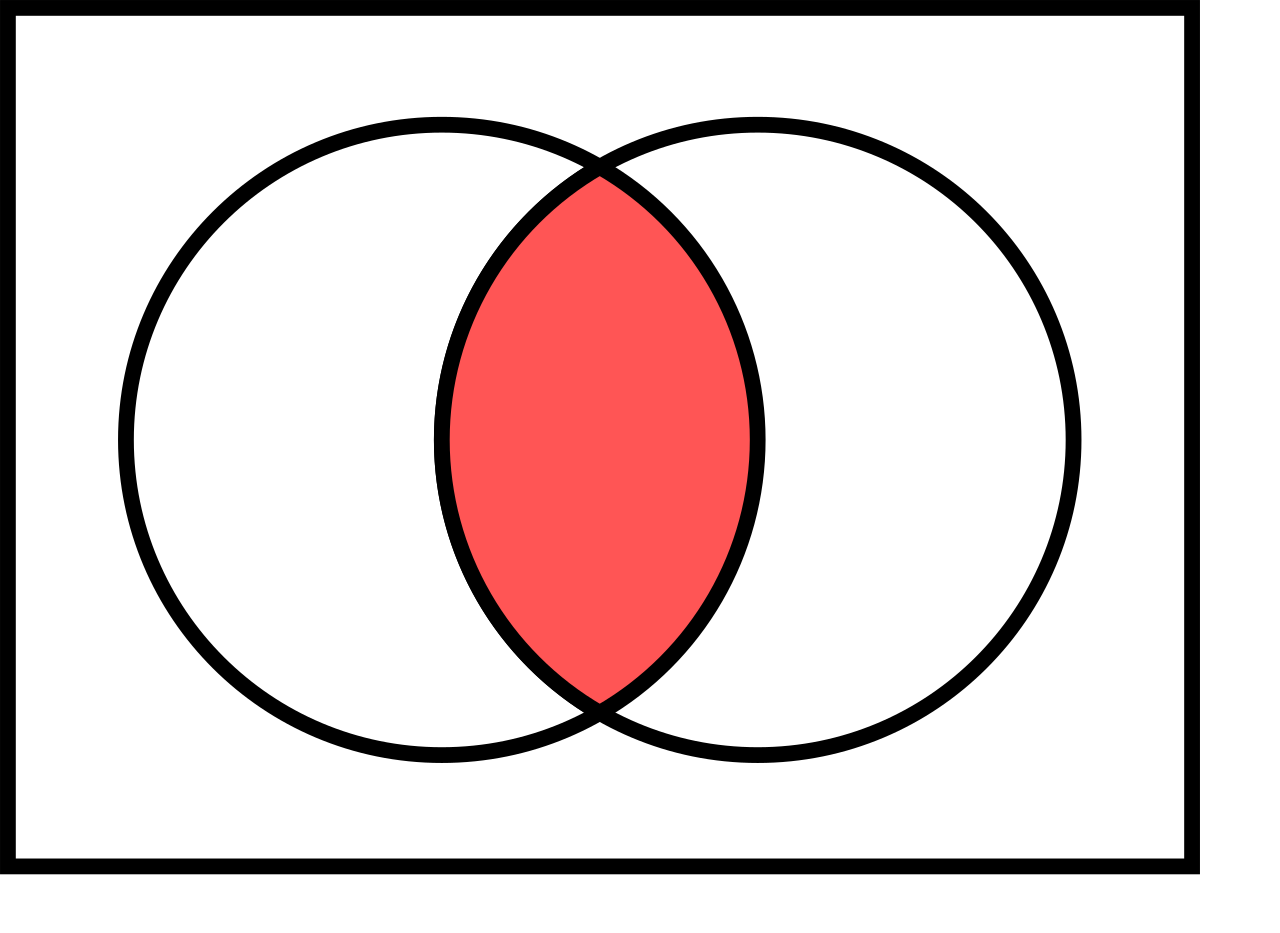
    • \(\text{Pr}(A \cup B) = \text{Pr}(A) + \text{Pr}(B) - \text{Pr}(A \cap B)\)
    • \(\text{Pr}(A \cap B) = \text{Pr}(A) + \text{Pr}(B) - \text{Pr}(A \cup B)\)
    • \(\text{Pr}(A^c) = 1 - \text{Pr}(A)\)
Recap from the motivation of logistic regression: When the probability of an event is \(A\) is \(\text{Pr}(A)=p\), then its odds (in favor of the event) are \(\frac{p}{1-p}\). The logistic regression model “raw” predictions are log-odds \(\log\frac{p}{1-p}\).

Conditional probability

Definition: The conditional probability of an event \(A\) given an event \(B\) (write “\(A | B\)”) is defined as

\[\text{Pr}(A|B) = \frac{\text{Pr}(A \cap B)}{\text{Pr}(B)}\]
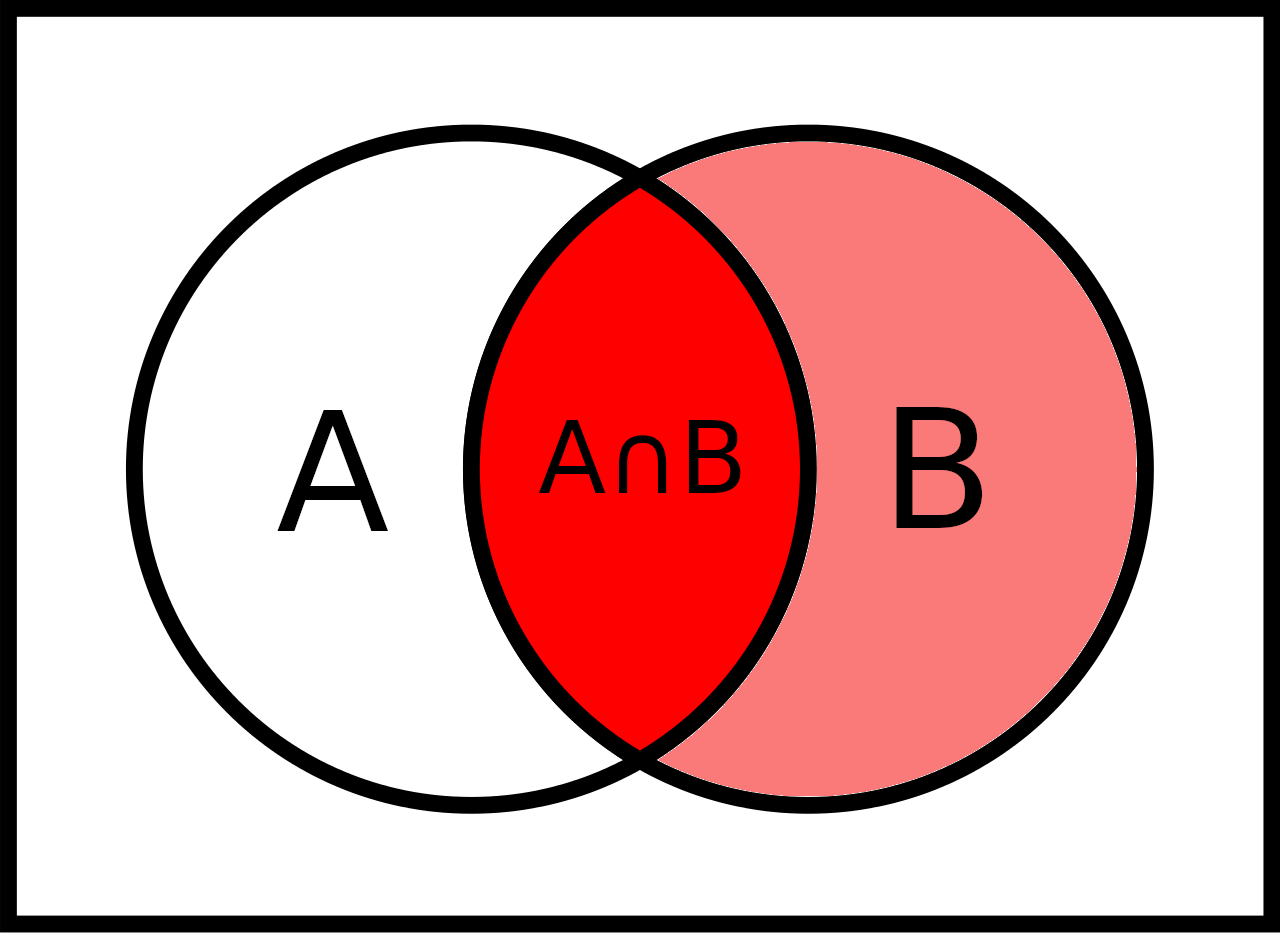
We want to know the probability of \(A\) given that we know that \(B\) has happened (or is happening for sure).

Two coin flips: \(A\) = “first coin is HEAD”, \(B\) = “one or zero HEADS in total”. What is \(\text{Pr}(A|B)\)? \(A\) = {HH, HT}, \(B\) = {TT, HT, TH} \(\to\) \(A \cap B = \{HT\}\)
\(\to\) \(\text{Pr}(A\cap B) = \frac{3}{4}\), \(\text{Pr}(A\cap B) = \frac{1}{4}\)
\(\to\) \(\text{Pr}(A|B) = \frac{1/4}{3/4} = \frac{1}{3}\)

More examples of conditional probability

COVID-19 Example: What is the probability that a random person in the tested sample has COVID-19 (event \(P\) “positive”) given that she has a positive test result (event \(PP\) “predicted positive”)?

\[\text{Pr}(P|PP) = \frac{\text{Pr}(P \cap PP)}{\text{Pr}(PP)}\]

Definition p-value: Probability of observed or more extreme outcome given that the null hypothesis (\(H_0\)) is true.

\[\text{p-value} = \text{Pr}(\text{observed or more extreme outcome for test-statistic} | H_0)\]

Probability in the Confusion Matrix

Confusion Matrix

Confusion matrix of statistical classification, large version:
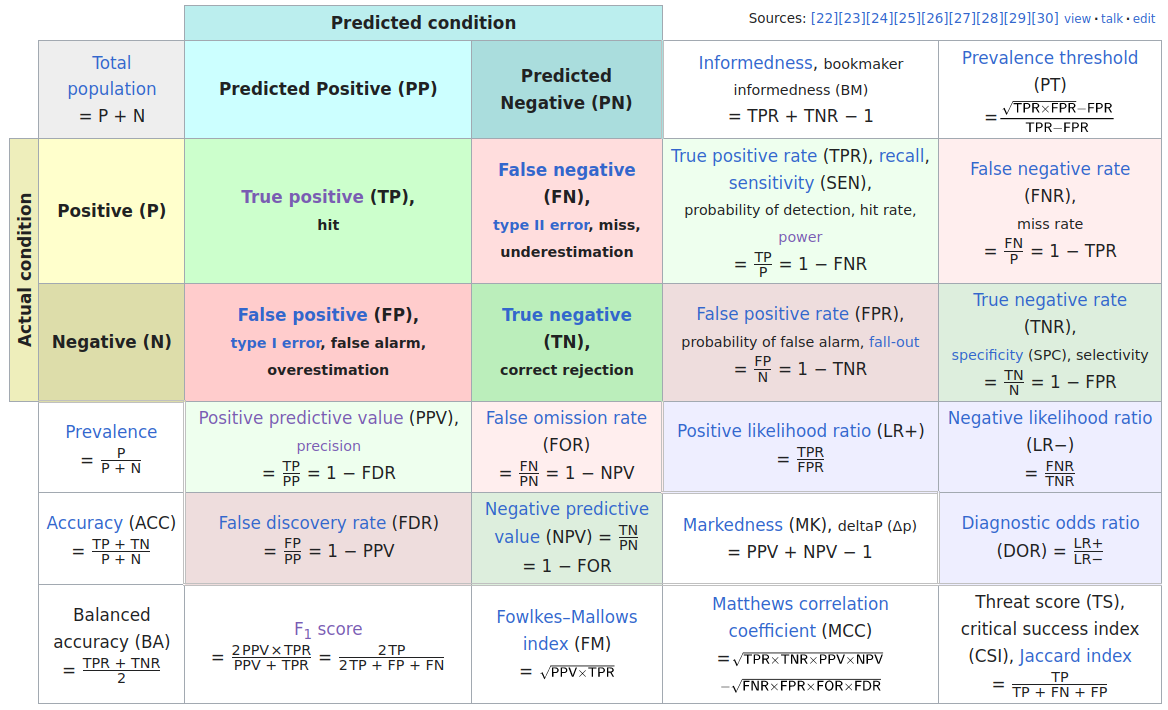
4 probabilities in confusion matrix

Sensitivity and Specificity

\(\to \atop \ \) Sensitivity is the true positive rate: TP / (TP + FN)
\(\ \atop \to\) Specificity is the true negative rate: TN / (TN + FP)

Positive/negative predictive value

\(\scriptsize\downarrow \ \) Positive predictive value: TP / (TP + FP)
\(\scriptsize\ \downarrow\) Negative predictive value: TN / (TN + FN)

Here TP, TN, FP, FN are the numbers of true positives, true negatives, false positives, and false negatives.

We can define fraction/probabilities for all the events \(P, N, PP, PTP, FP, FN, TN\) by dividing by \(n = TP + FP + FN + TN\).1

For example: \(\text{Pr}(TP) = \frac{TP}{n}\), \(\text{Pr}(P) = \frac{P}{n}\), \(\text{Pr}(PP) = \frac{PP}{n}\), …

… as conditional probabilities

Sensitivity and specificity are conditional probabilities:

  • Sensitivity is the probability of a positive test result given that the person has the condition: \(\text{Pr}(PP|P) = \frac{TP}{P} = \frac{\text{Pr}(TP)}{\text{Pr}(P)}\)

  • Specificity is the probability of a negative test result given that the person does not have the condition: \(\text{Pr}(PN|N) = \frac{TN}{N} = \frac{\text{Pr}(TN)}{\text{Pr}(N)}\)

  • Positive predictive value is the probability of the condition given that the test result is positive: \(\text{Pr}(P|PP) = \frac{TP}{PP} = \frac{\text{Pr}(TP)}{\text{Pr}(PP)}\)

  • Negative predictive value is the probability of the condition given that the test result is negative: \(\text{Pr}(N|PN) = \frac{TN}{N} = \frac{\text{Pr}(TN)}{\text{Pr}(PN)}\)

“Flipping” conditional in positive predictive value \(\text{Pr}(P|PP)\) is sensitivity \(\text{Pr}(PP|P)\).

Positive predicted value answers the question: Given I have been tested positive, what is the probabilitiy, I have it?

Bayes’ Theorem

Bayes’ Theorem is a fundamental theorem in probability theory that relates the conditional probabilities \(\text{Pr}(A|B)\) and \(\text{Pr}(B|A)\) to the marginal probabilities \(\text{Pr}(A)\) and \(\text{Pr}(B)\):

\[\text{Pr}(A|B) = \frac{\text{Pr}(B|A) \cdot \text{Pr}(A)}{\text{Pr}(B)}\]

Example: What is the probability that a random person in the tested sample has COVID-19 (\(P\) = positive) given that she has a positive test result (\(PP\) = predicted positive)?

\[\text{Pr}(P|PP) = \frac{\text{Pr}(PP|P) \cdot \text{Pr}(P)}{\text{Pr}(PP)}\] So, we can compute the positive predictive value \(\text{Pr}(P|PP)\) from the sensitivity \(\text{Pr}(PP|P)\) and the rate (or probability) of positive conditions \(\text{Pr}(P)\) and the rate (or probability) of positive tests \(\text{Pr}(PP)\).

Prevalence

  • The rate (or probability) of the positive conditions in the population is also called Prevalence:

\[\text{Pr}(P) = \frac{P}{n} = \frac{TP + FN}{n}\]

  • Sensitivity and Specificity are properties of the test (or classifier) and are independent of the prevalence of the condition in the population of interest.

  • The Positive/Negative Predictive Values are not!

How the positive predictive value (PPV) depends on prevalence

We assume a test with sensitivity 0.9 and specificity 0.99. \(N = 1000\) people were tested.

  PP PN
P TP FN
N FP TN

Sensitivity = TP / P
Specificity = TN / N
PPV = TP / PP
Prevalence = P / N

Prevalence = 0.1

\(P\) = 100 \(N\) = 900

  PP PN
P 90 10
N 9 891

PPV = 90 / (90 + 9) = 0.909

From the positive tests 90.9% have COVID-19.

Prevalence = 0.01

\(P\) = 10 \(N\) = 990

  PP PN
P 9 1
N 9.9 980.1

PPV = 9 / (9 + 9.9) = 0.476

From the positive tests only 47.6% have COVID-19!

Random variables

How to think about random variables

In statistics (that means, in data):
A theoretical assumption about a numerical variable in a data frame.

In probability (that means, in theory):
A mapping of events (subsets of a sample space of atomic events) to numerical values.

Why?
For random variables we can:

  • Conceptualize meaningful values to random events like payoffs, costs, or grades
  • Compute probabilities of these numerical values
  • Compute the expected value of a numerical variable
  • Theorize about their distribution and their distribution and density functions (e.g. binomial, normal, lognormal, etc.)

Random variable mathematically

A random variable is

  • a function \(X: S \to \mathbb{R}\) from a sample space \(S\) to the real numbers \(\mathbb{R}\),
  • which assigns a value to each atomic event in the sample space.

Together with a probability function \(\text{Pr}: \mathcal{F}(S)\to [0,1]\) probabilities can be assigned to values of the random variable (see the probability mass function in explained later).

Examples of random variables

3 random processes spaces and an example of a random variable \(X\):

Two coin tosses:
Sample space: \(\{HH, HT, TH, TT\}\)
We define \(X\) as the number of HEADS.
Values of \(X\): \(HH \to 2\), \(HT \to 1\), \(TH \to 1\), and \(TT \to 0\).

62 randomly selected organ donations:
Sample space: All possibilities to select 62 organ donations
We define \(X\) to be the number of complications (compare Hypothesis Testing material).
Values of \(X\): 0, 1, 2,…, 61, 62

Select a random palmer penguin:
We define \(X\) as its flipper length.
Sample space: All penguins in dataset
Values of \(X\): flipper_length_mm

Summary: A random variable is a way to look at a numerical aspect of a sample space. It often simplfies because more atomic events may be mapped to the same number.

Discrete vs. continuous

A random variable \(X\) can be either

Discrete: \(X\) can take only a finite number of possible numeric values. Or:

Continuous: \(X\) can take values from an infinite set of real numbers (for example an interval or all positive real numbers)

Are these random variables discrete or continuous?

  1. Number of HEADs of two coin tosses: Discrete
  2. Number of complications in 62 organ donations: Discrete
  3. Flipper length of a random row in palmer penguins data frame: Discrete
  4. Flipper length of a random penguin in the world: Continuous

For working with data: Every data frame is finite, so every random variable built on data variable dataset is technically discrete. However, it can make sense to assume it as continuous because of its continuous nature. (In variables of continuous nature, many or all values are unique.)

Probability mass function (pmf)

For

  • a discrete random variable \(X\) and
  • a probability function \(\text{Pr}\)

the probability mass function \(f_X: \mathbb{R} \to [0,1]\) is defined as

\[f_X(x) = \text{Pr}(X=x),\]

where \(\text{Pr}(X=x)\) is an abbreviation for \(\text{Pr}(\{a\in S\text{ for which } X(a) = x\})\).

Example pmf for 2 coin tosses

Two coin tosses \(S = \{HH, HT, TH, TT\}\)

  • We define \(X\) to be the number of heads:
    \(X(HH) = 2\), \(X(TH) = 1\), \(X(HT) = 1\), and \(X(TT) = 0\).
  • We assume the probability function \(\text{Pr}\) assigns for each atomic event a probability of 0.25.
  • Then the probability mass function is \[\begin{align} f_X(0) = & \text{Pr}(X=0) = \text{Pr}(\{TT\}) & = 0.25 \\ f_X(1) = & \text{Pr}(X=1) = \text{Pr}(\{HT,TH\}) & = 0.25 + 0.25 = 0.5 \\ f_X(2) = &\text{Pr}(X=2) = \text{Pr}(\{HH\}) & = 0.25\end{align}\]
  • Note that \(\text{Pr}(\{HT,TH\}) = \text{Pr}(\{HT\}) + \text{Pr}(\{HT\})\) by adding the probabilities of the atomic events.
  • For all \(x\) which are not 0, 1, or 2: Obviously, \(f_X(x) = 0\).

Example: Roll two dice 🎲 🎲

Random variable: The sum of both dice.

Events: All 36 combinations of rolls 1+1, 1+2, 1+3, 1+4, 1+5, 1+6, 2+1, 2+2, 2+3, 2+4, 2+5, 2+6, 3+1, 3+2, 3+3, 3+4, 3+5, 3+6, 4+1, 4+2, 4+3, 4+4, 4+5, 4+6, 5+1, 5+2, 5+3, 5+4, 5+5, 5+6, 6+1, 6+2, 6+3, 6+4, 6+5, 6+6

Possible values of the random variable: 2, 3, 4, 5, 6, 7, 8, 9, 10, 11, 12 (These are numbers.)

Probability mass function: (Assuming each number has probability of \(\frac{1}{6}\) for each die.)

\(\text{Pr}(2) = \text{Pr}(12) = \frac{1}{36}\)
\(\text{Pr}(3) = \text{Pr}(11) = \frac{2}{36}\)
\(\text{Pr}(4) = \text{Pr}(10) = \frac{3}{36}\)
\(\text{Pr}(5) = \text{Pr}(9) = \frac{4}{36}\)
\(\text{Pr}(6) = \text{Pr}(8) = \frac{5}{36}\)
\(\text{Pr}(7) = \frac{6}{36}\)
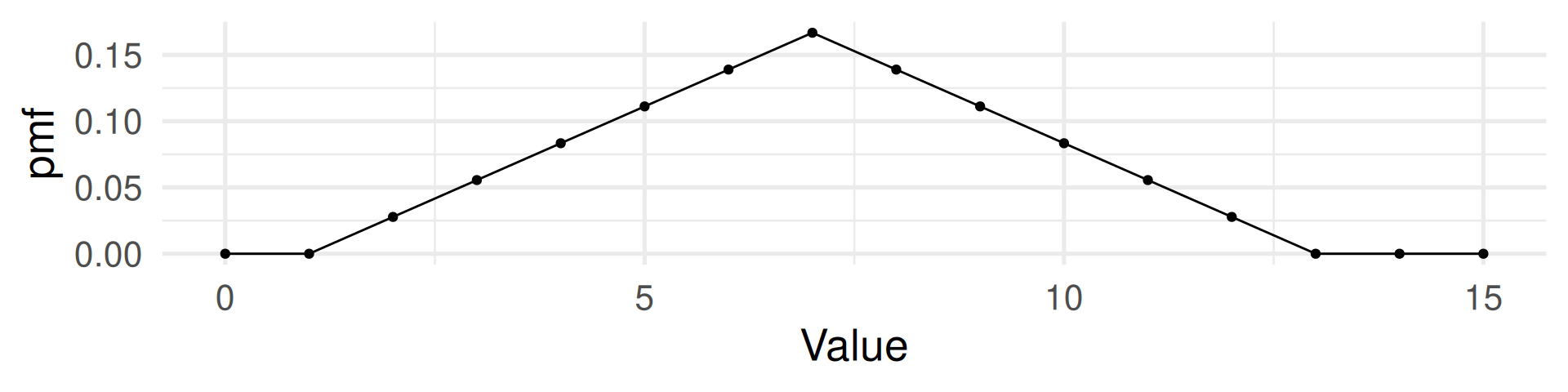
tibble(Value = 0:15, 
       pmf=c(0,0,1,2,3,4,5,6,5,4,3,2,1,0,0,0)/36) |> 
 ggplot(aes(Value,pmf)) + geom_line() + geom_point() +
 theme_minimal(base_size = 20)

Expected value

  • For a discrete random variable \(X\), there is only a finite set of number \(X\) can take: \(\{x_1,\dots,x_k\}\).
  • So, the probability mass function has maximally \(k\) positive probabilities: \(p_1,\dots,p_k\)
  • Recall \(p_i = f_X(x_i) = \text{Pr}(X=x_i) = \text{Pr}(\{a \in S \text{ for which } X(a) = x_i \})\).

The expected value of \(X\) is defined as \(E(X) = \sum_{i=1}^k p_i x_i = p_1x_1 + \dots + p_kx_k.\)

Think of \(E(X)\) as the probability weighted arithmetic mean of all possible values of \(X\).

Examples: \(X\) one roll of a die 🎲.
\(E(X) = 1\cdot\frac{1}{6} + 2\cdot\frac{1}{6} + 3\cdot\frac{1}{6} + 4\cdot\frac{1}{6} + 5\cdot\frac{1}{6} + 6\cdot\frac{1}{6} = \frac{21}{6} = 3.5\)

\(X\) sum of two die rolls 🎲🎲.
\(E(X) = 2\cdot\frac{1}{36} + 3\cdot\frac{2}{36} + 4\cdot\frac{3}{36} + 5\cdot\frac{4}{36} + \dots + 10\cdot\frac{3}{36} + 11\cdot\frac{2}{36} + 12\cdot\frac{1}{36} = 7\)

\(X\) flipper length in penguins from Palmer penguins: \(E(X) = 200.966967\)
mean(penguins$flipper_length_mm, na.rm = TRUE)

Distributions of Random Variables

  • The distribution of a random variable \(X\) is a table, graph, or formula that gives the probabilities of all its possible values.
Type of Random Variable Table Graph Formula
Discrete
Continuous
  • The probability mass function \(f_X\) defines the distribution of a random variable \(X\) that is discrete.

  • The probability density function \(f_X\) defines the distribution of a random variable \(X\) that is continuous. (Details later)

  • For a column in a data frame the distribution is typically visualized by

    • a bar plot of counts or frequencies for discrete variables
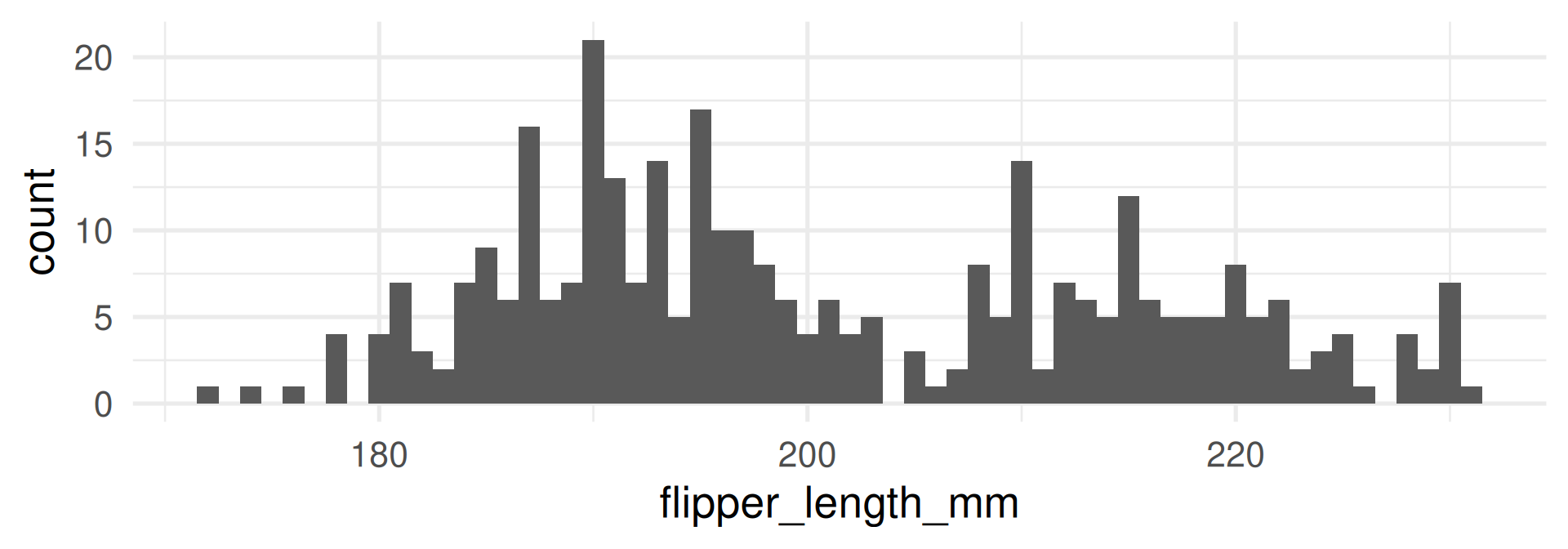
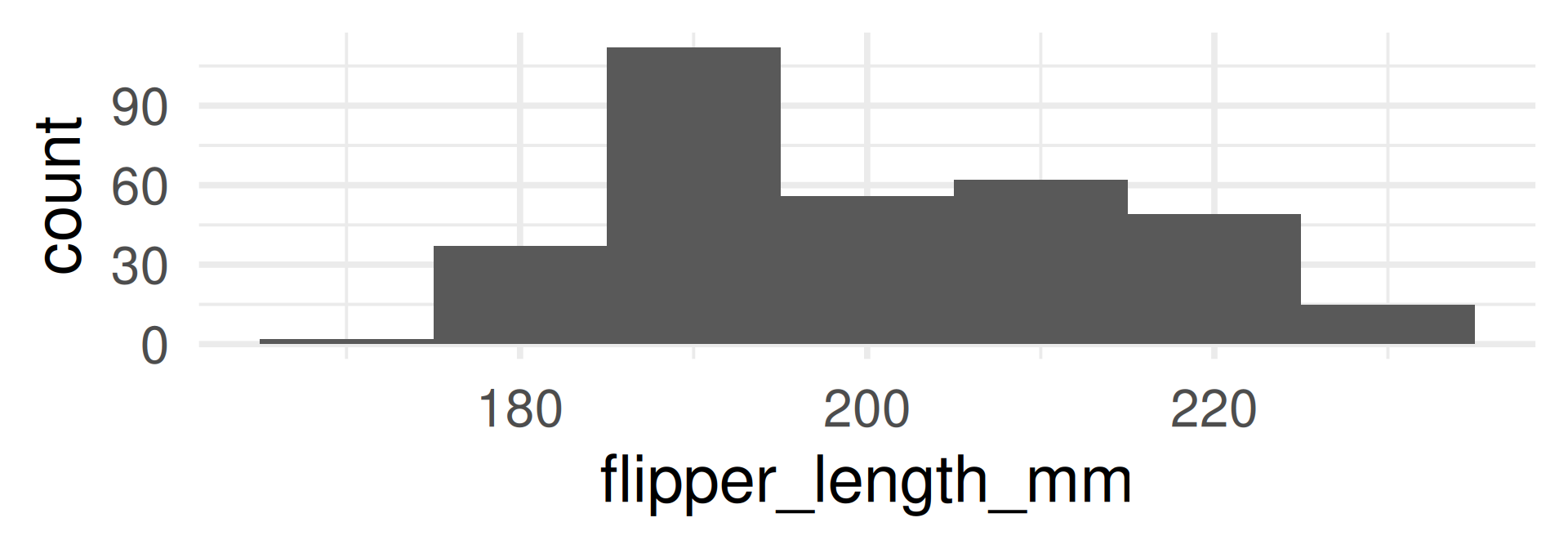
    • a histogram for continuous variables (note, depending on the binwidth this gives a more or less detailed impression of the distribution)

Examples of data distributions

Discrete
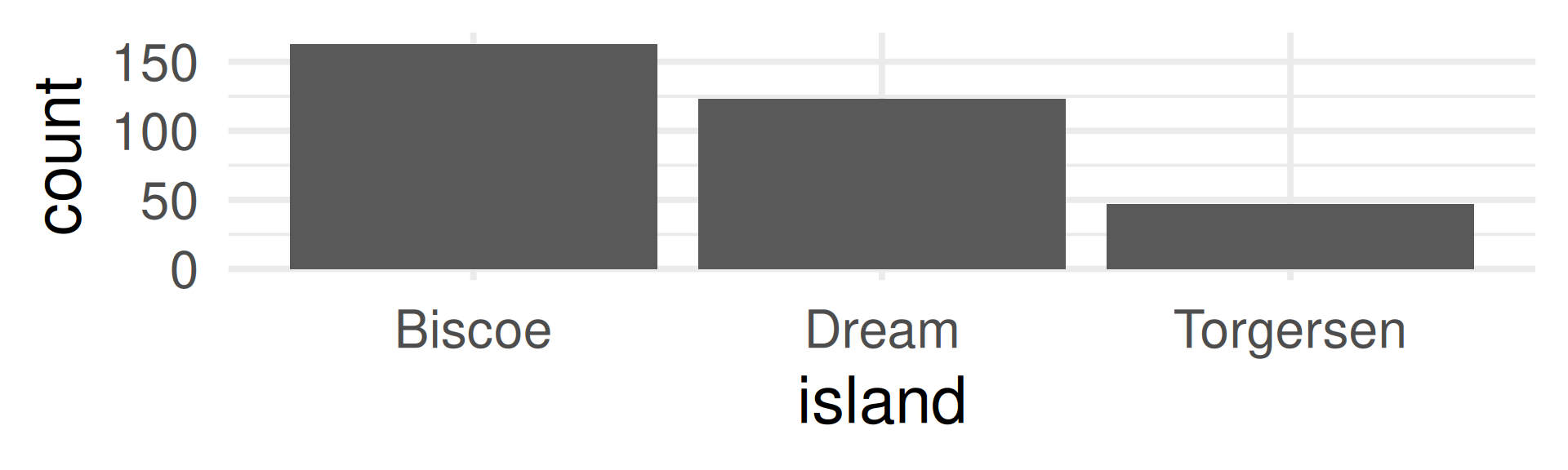
penguins |> 
 ggplot(aes(island)) + 
 geom_bar() + 
 theme_minimal(base_size = 30)

Technically island is cannot be interpreted as a random variable because its values are not numbers, but we also speak about the distribution of the variables.
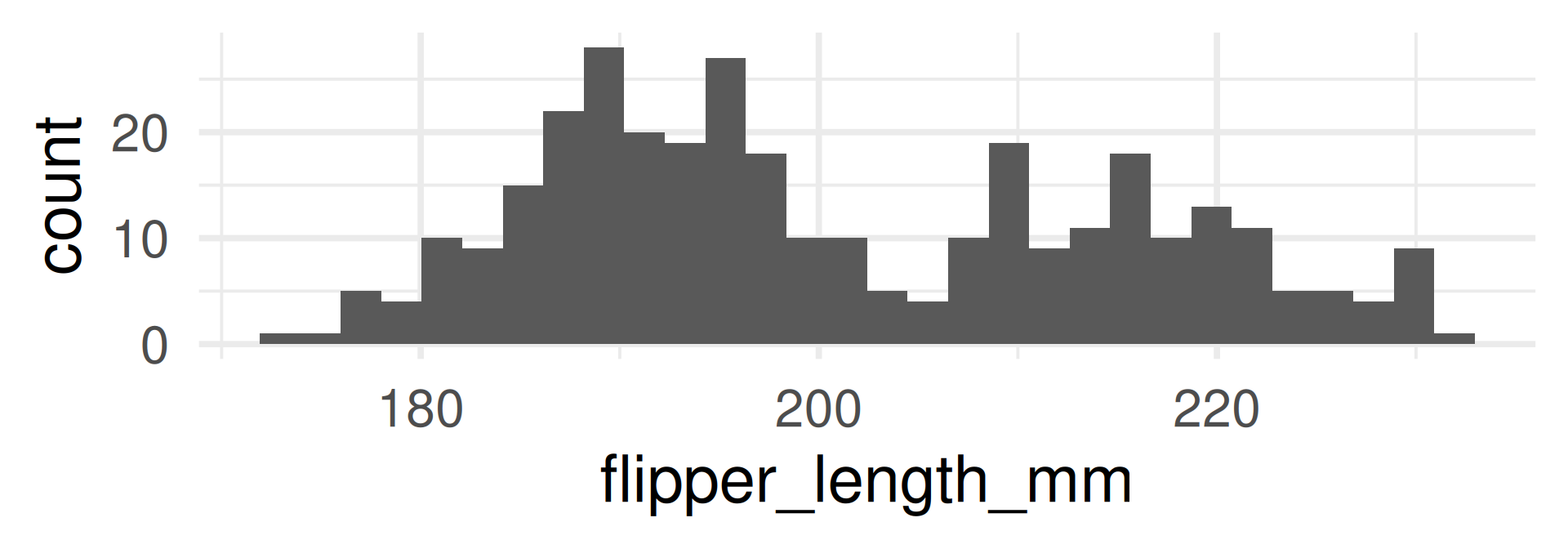
Continuous in nature
(technically still discrete)

penguins |> 
 ggplot(aes(flipper_length_mm)) + 
 geom_histogram() + theme_minimal(base_size = 30)

Larger bin width

penguins |> 
 ggplot(aes(flipper_length_mm)) + 
 geom_histogram(binwidth = 10) + theme_minimal(base_size = 30)

Smallest bin width

penguins |> 
 ggplot(aes(flipper_length_mm)) + 
 geom_histogram(binwidth = 1) + theme_minimal(base_size = 20)

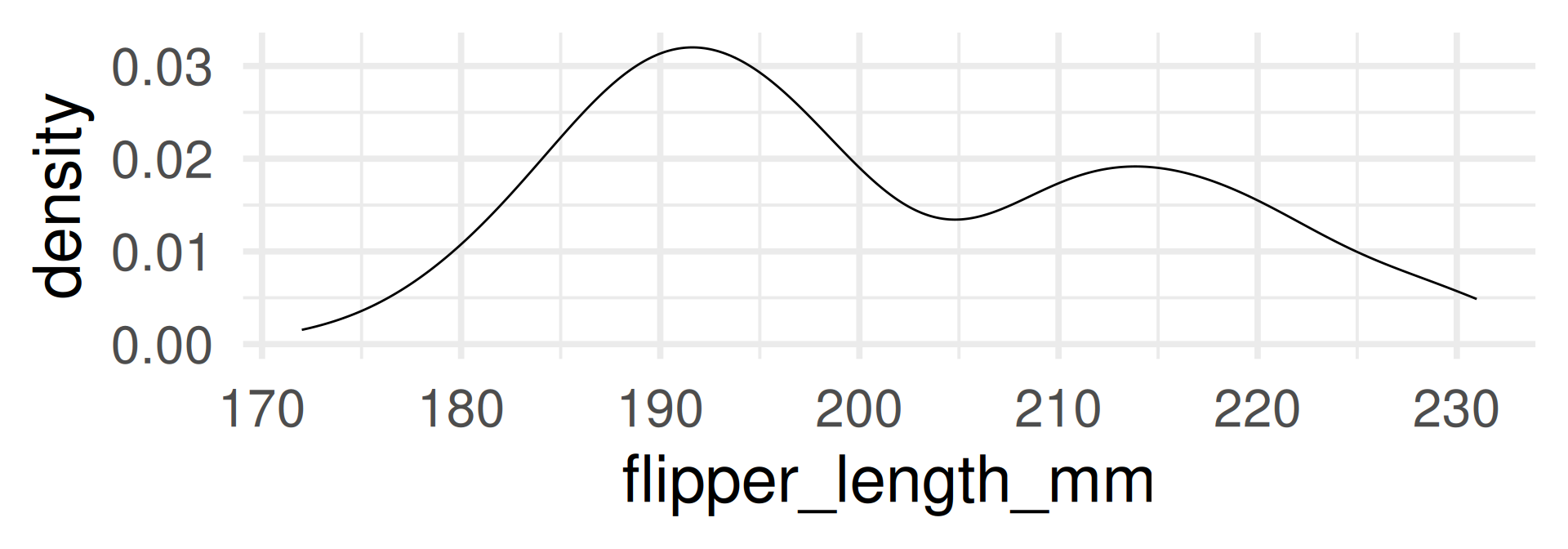
Density plot

penguins |> 
 ggplot(aes(flipper_length_mm)) + 
 geom_density() + theme_minimal(base_size = 30)

Density plot

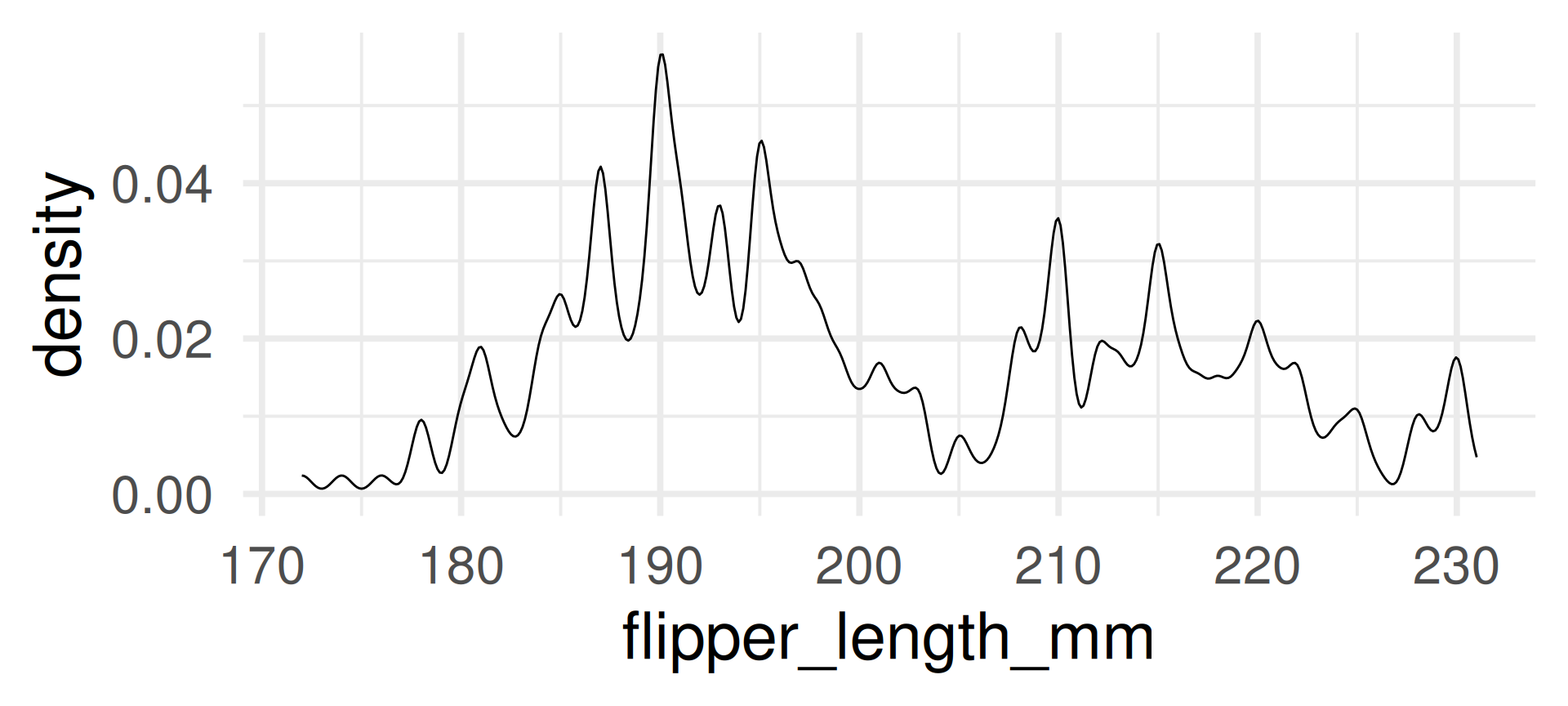
  • The density plot is a smoothed version of the histogram.
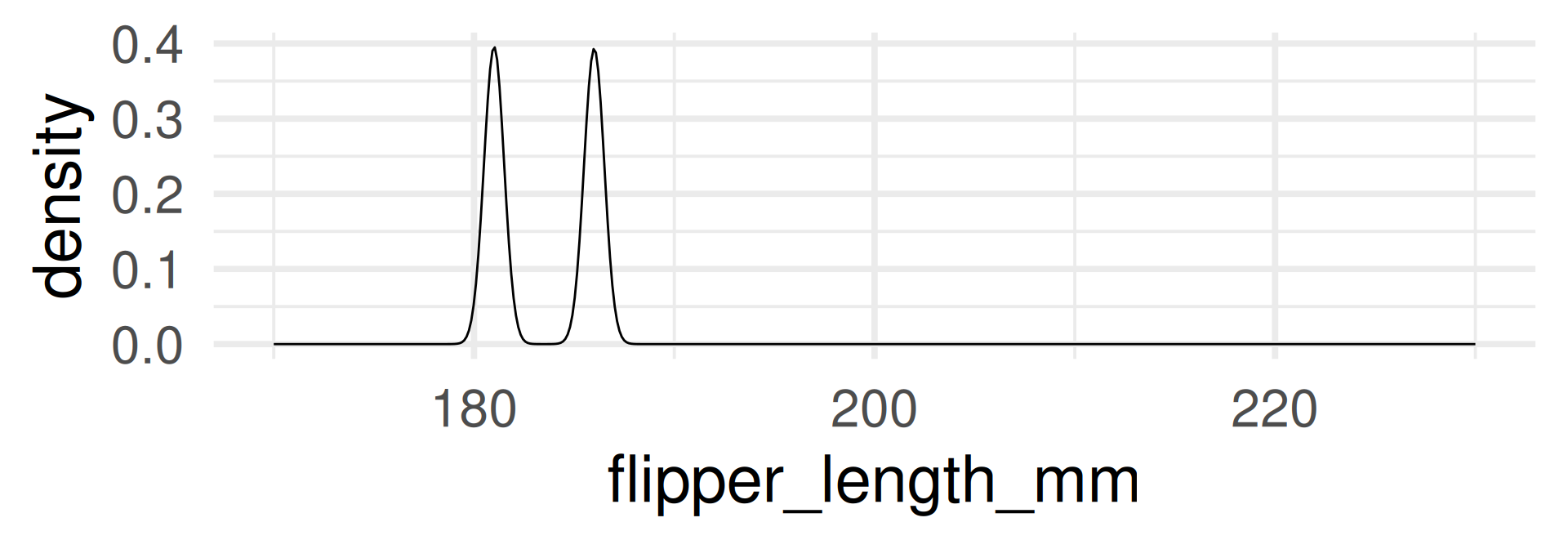
  • Each data point is replaced by a kernel (e.g. a normal distribution, see later) and the sum of all kernels is plotted.

With automatic bandwidth (bw)
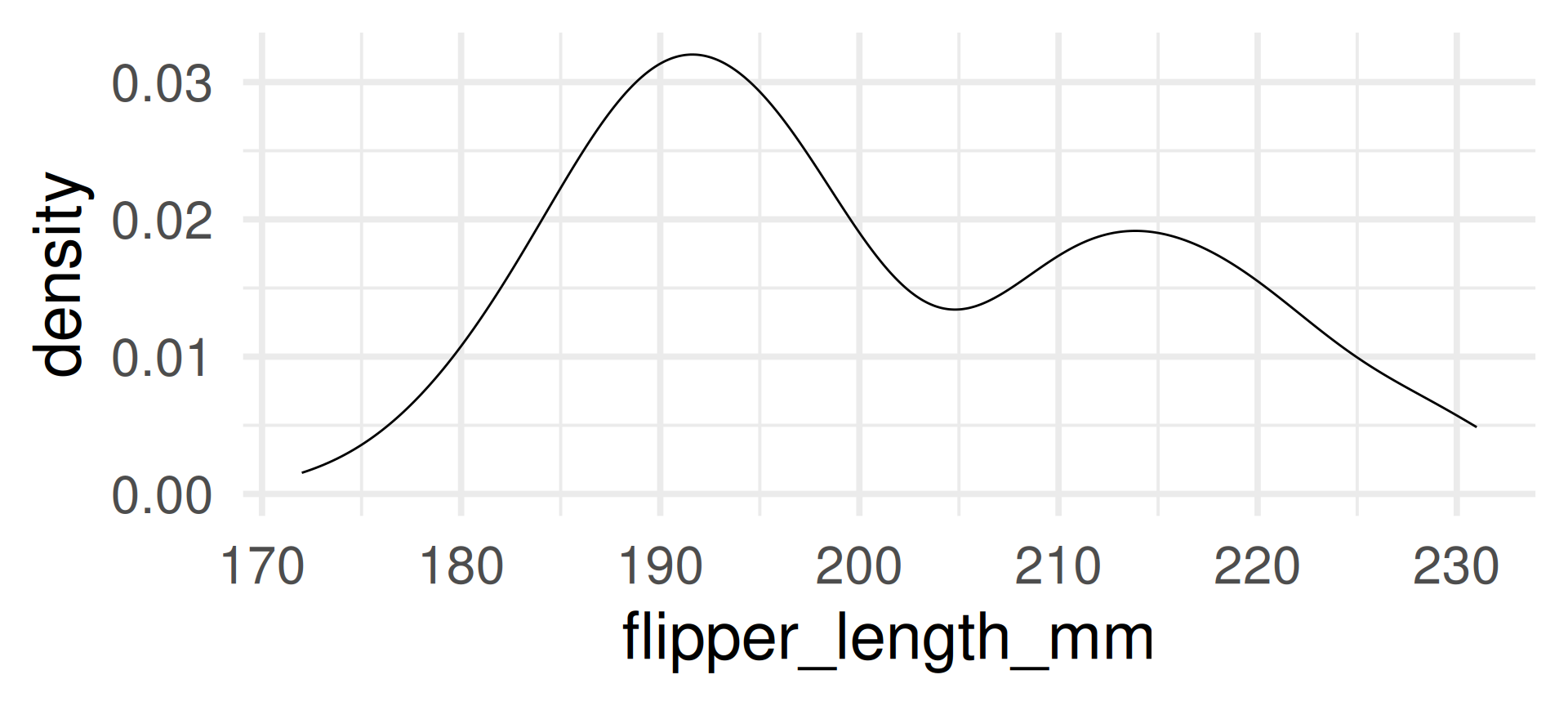
penguins |> 
 ggplot(aes(flipper_length_mm)) + 
 geom_density() + 
 theme_minimal(base_size = 30)

bw = 0.5 means kernel has standard deviation 0.5

penguins |> 
 ggplot(aes(flipper_length_mm)) + 
 geom_density(bw = 0.5) + 
 theme_minimal(base_size = 30)

For demonstration:
2 penguins only

penguins |> slice(1:2) |> 
 ggplot(aes(flipper_length_mm)) + 
 geom_density(bw = 0.5) + xlim(c(170,230)) + 
 theme_minimal(base_size = 30)

See the two kernels

Binomial distribution

A first example for a theoretical random variable.

Binomial distribution

The number of HEADS in several coin tosses and the number of complications in randomly selected organ donations are examples of random variable which have a binomial distribution.

Definition:
The binomial distribution with parameters \(n\) and \(p\) is
the number of successes in a sequence of \(n\) independent Bernoulli trials
which each delivers a success with probability \(p\) and a failure with probability \((1-p)\).

Binomial probability mass function

\[f(k,n,p) = \Pr(k;n,p) = \Pr(X = k) = \binom{n}{k}p^k(1-p)^{n-k}\]

where \(k\) is the number of successes, \(n\) is the number of Bernoulli trials, and \(p\) the success probability.

Probability to have exactly 3 complications in 62 randomly selected organ donations with complication probability \(p=0.1\) is

# x represents k, and size represents n
dbinom(x = 3, size = 62, prob = 0.1)
[1] 0.07551437

The probability to have 3 complications or less can be computed as

dbinom(3, 62, 0.1) + dbinom(2, 62, 0.1) + dbinom(1, 62, 0.1) + dbinom(0, 62, 0.1)
[1] 0.1209787

This was the p-value we computed with simulation for the hypothesis testing example.

Expected value binomial distribution

For \(X \sim \text{Binom}(n,p)\) (read “\(X\) has a binomial distribution with samplesize \(n\) and success probability \(p\)”)

The expected value of \(X\) is by definition

\[E(X) = \underbrace{\sum_{k = 0}^n k}_{\text{sum over successes}} \cdot \underbrace{\binom{n}{k}p^k(1-p)^{n-k}}_{\text{probability of successes}}\]

Computation shows that \(E(X) = p\cdot n\).

Example: For \(n = 62\) organ donations with complication probability \(p=0.1\), the expected number of complications is \(E(X) = 6.2\).

Distribution functions are vectorized!

Compute the p-value:

dbinom(0:3, 62, 0.1) 
[1] 0.001455578 0.010027317 0.033981465 0.075514366
dbinom(0:3, 62, 0.1) |> sum()
[1] 0.1209787

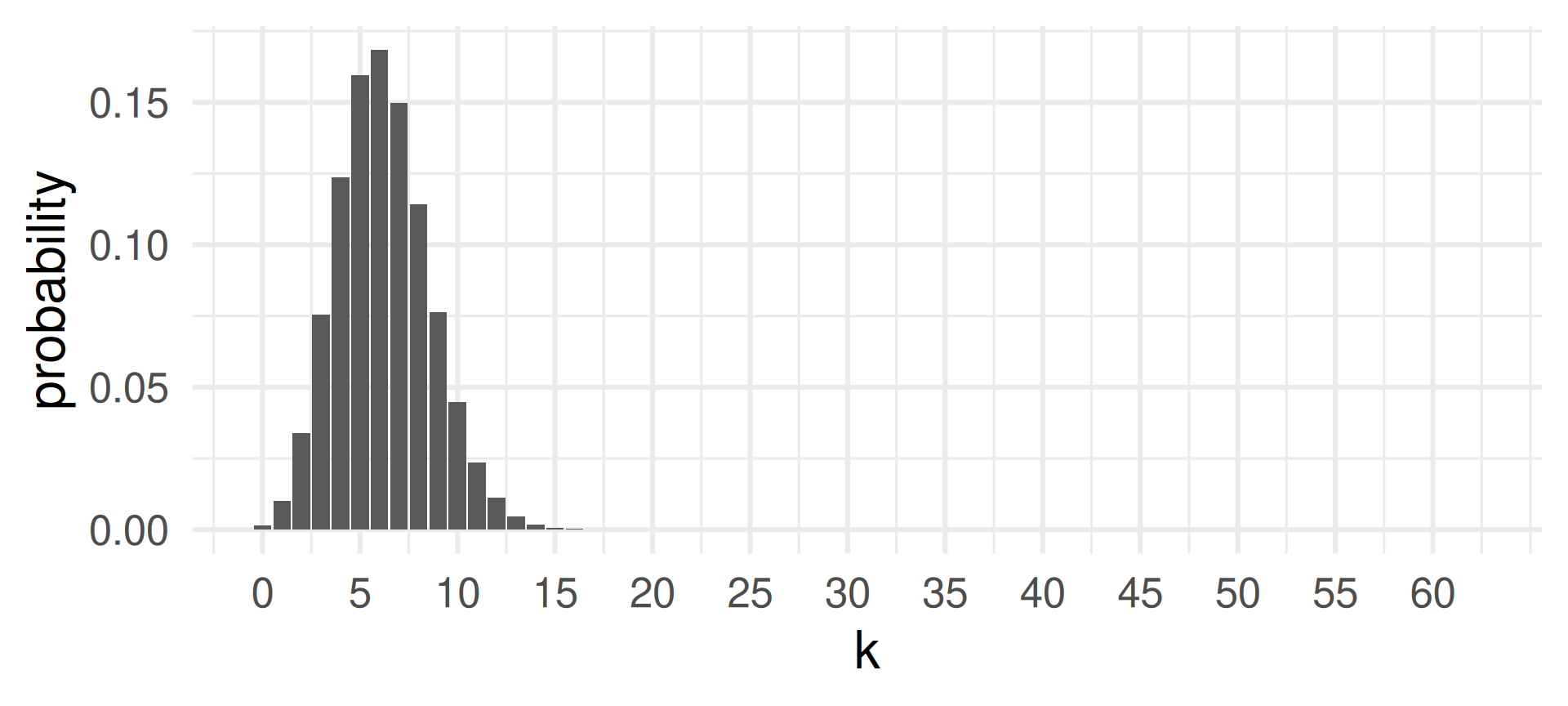
Plotting the probability mass function

tibble(k = 0:62) |> 
 mutate(probability = dbinom(k, 
                             size = 62, 
                             prob = 0.1)) |> 
 ggplot(aes(k, probability)) + 
 geom_col() + 
 theme_minimal(base_size = 24) + 
 scale_x_continuous(breaks = seq(0, 62, 5))

See that the highest probability is achieved for \(k=6\) which is close to the expected value of successes \(E(X) = 6.2\) for \(X \sim \text{Binom}(62,0.1)\).

Other plots of binomial mass function

Changing the sample size \(n\) when the success probability \(p = 0.1\) and the number of successes \(k=3\) is fixed:
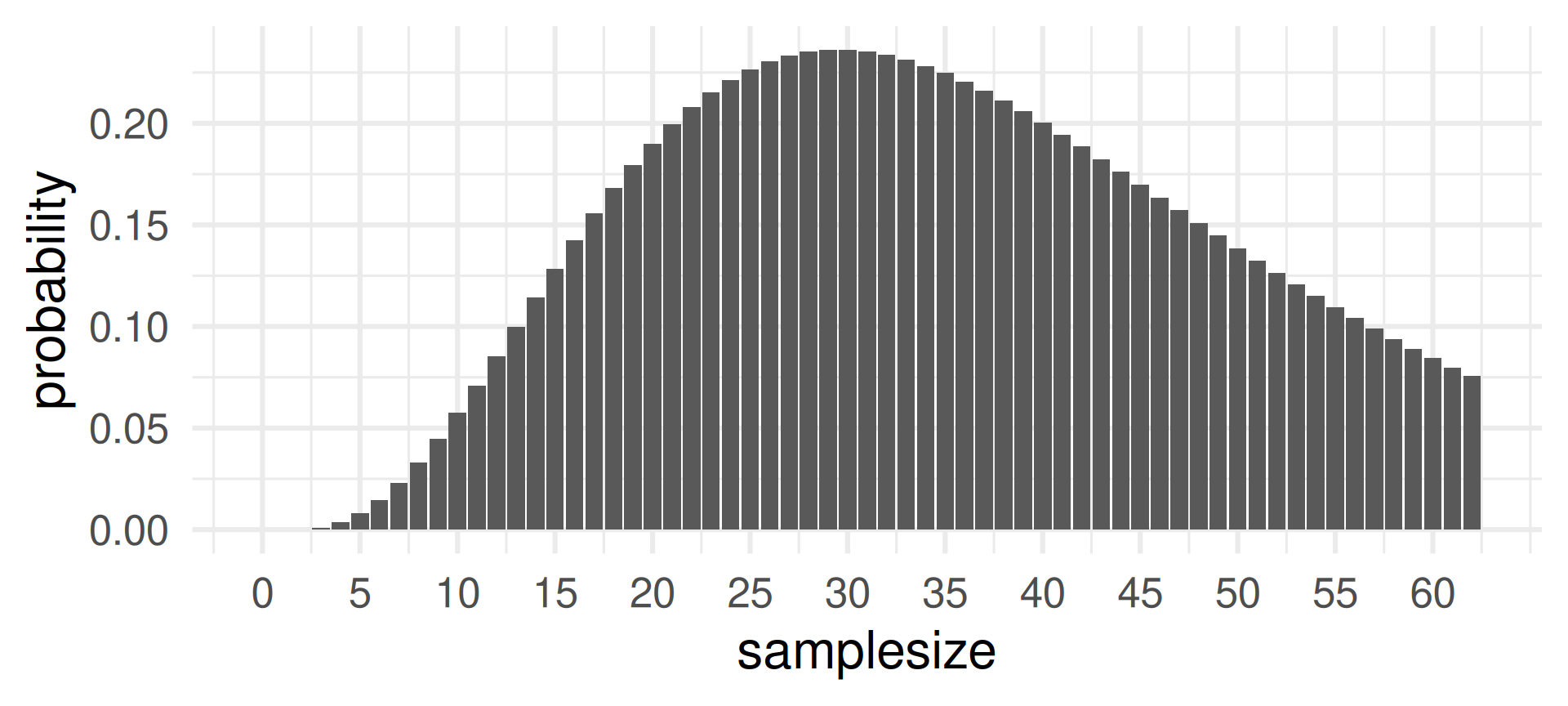
tibble(samplesize = 0:62) |> 
 mutate(probability = dbinom(3, 
                             size = samplesize, 
                             prob = 0.1)) |> 
 ggplot(aes(samplesize, probability)) + 
 geom_col() + 
 theme_minimal(base_size = 24) +
 scale_x_continuous(breaks = seq(0, 62, 5))

The probability of 3 successes is most likely for sample sizes around 30. Does is make sense?

Yes, because for \(n=30\) the expected value for probability \(p=0.1\) is \(3 = pn = 0.1\cdot 30\).

Other plots of binomial mass function

Changing the sample size \(p\) when the sample size \(n = 62\) and the number of successes \(k=3\) is fixed:
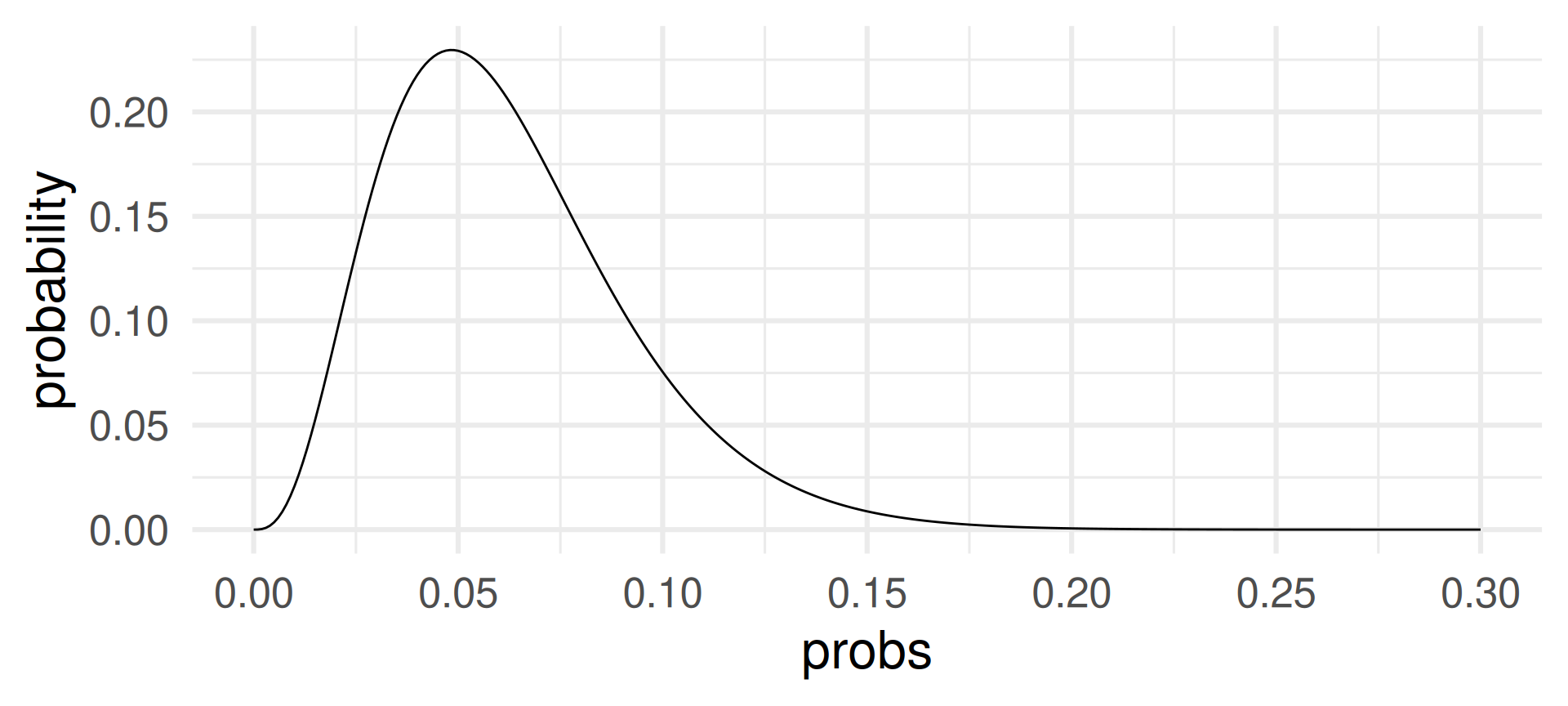
tibble(probs = seq(0,0.3,0.001)) |> 
 mutate(probability = dbinom(3, 
                             size = 62, 
                             prob = probs)) |> 
 ggplot(aes(probs, probability)) + 
 geom_line() +
 scale_x_continuous(breaks = seq(0,0.3,0.05)) + 
 theme_minimal(base_size = 24)

The probability of 3 successes in 62 draws is most likely for success probabilities around 0.05.

For \(p=0.05\) the expected value for \(n=62\) is \(pn = 0.05\cdot 62 = 3.1\).